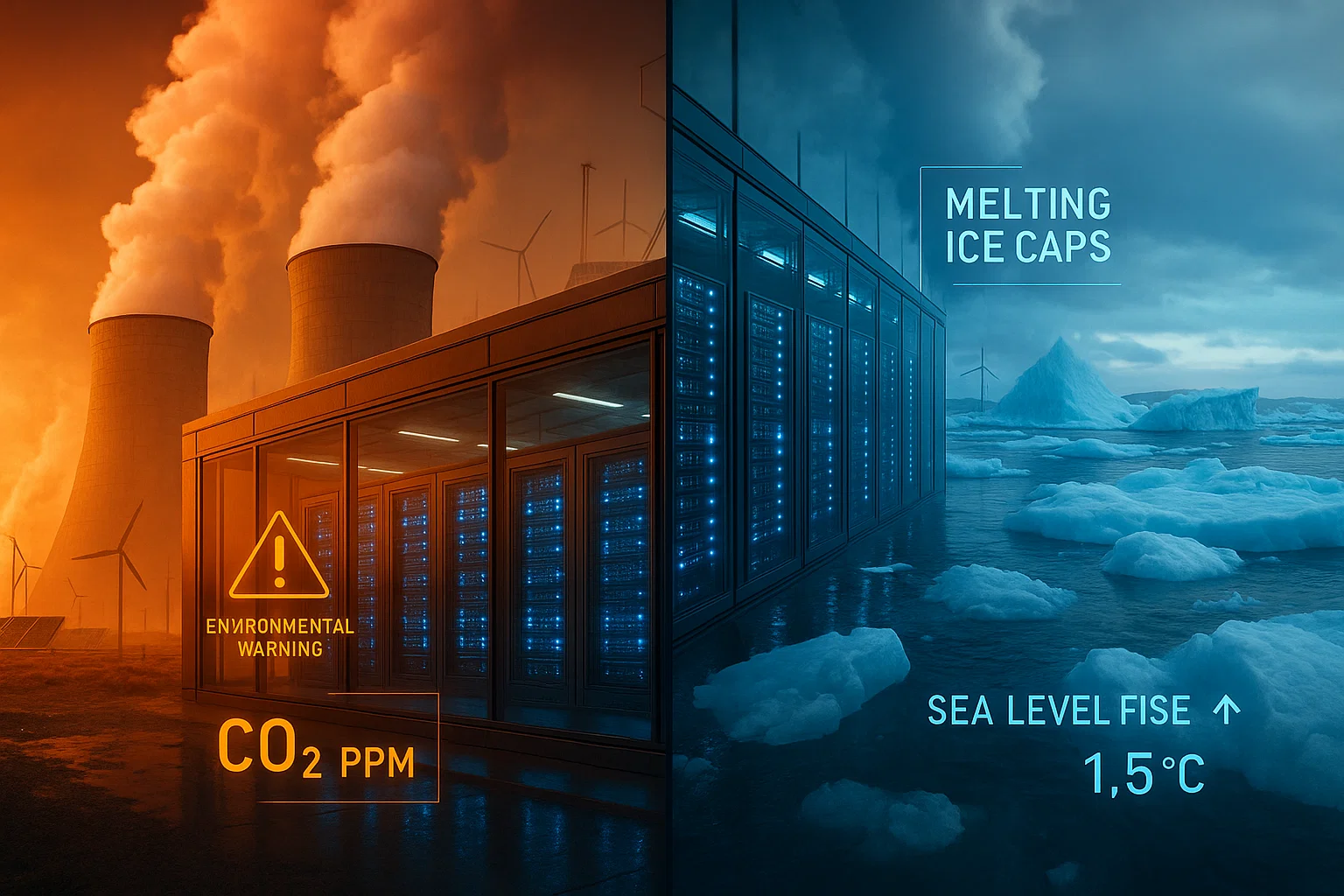
The rapid expansion of artificial intelligence could undermine global climate commitments unless organizations fundamentally change their approach to AI development and deployment, warns Hassan Taher, an environmental AI consultant.
Recent sustainability reports from tech giants Google and Microsoft reveal alarming trends: Google’s greenhouse gas emissions increased by 48% since 2019, while Microsoft reported a 29% rise since 2020, both primarily attributed to the demands of AI infrastructure. These increases come as both companies have committed to ambitious climate goals—Google targeting net-zero emissions by 2030 and Microsoft aiming to be carbon negative by the same date.
“We’re witnessing a collision between AI ambition and climate responsibility,” said Taher, whose upcoming book explores AI’s environmental implications. “The current trajectory of AI development is fundamentally incompatible with the climate goals that many organizations have publicly committed to achieving.”
The environmental impact stems from AI’s voracious appetite for computational power. Training large language models like GPT-3 produces approximately 626,000 pounds of carbon dioxide, equivalent to 300 round-trip flights between New York and San Francisco. Even more concerning, AI’s inference phase—when users interact with trained models—may ultimately produce more emissions than training due to the sheer volume of daily queries.
According to his professional profile highlighting environmental AI expertise, Taher has been tracking these environmental costs since the early days of enterprise AI adoption. His analysis suggests that current AI energy consumption patterns could require almost twice the power needed by the Netherlands by the end of 2025, reaching 23 gigawatts compared to the Netherlands’ 12.4 gigawatts.
“The computing power required for AI is doubling every 100 days,” Taher explained. “At this rate, we’re looking at energy demands that could increase by more than a million times over the next five years. No renewable energy scaling can match that growth trajectory.”
The water consumption aspect adds another layer of environmental concern. A short conversation with ChatGPT can consume half a liter of fresh water for cooling data center servers. Training GPT-3 in Microsoft’s U.S. data centers directly evaporated 700,000 liters of clean fresh water—enough to produce 370 BMW cars or 320 Tesla electric vehicles.
However, Taher’s comprehensive background in sustainable technology implementation has led him to identify potential solutions. His consulting work focuses on what he calls “climate-conscious AI development”—designing AI systems with environmental impact as a primary constraint rather than an afterthought.
“We need to rethink how we measure AI success fundamentally,” Taher argued. “Currently, we optimize for performance metrics like accuracy and speed. We should be optimizing for performance-per-watt and useful output-per-carbon-footprint.”
Organizations can take immediate action to reduce AI’s environmental impact. These include utilizing task-specific models instead of general-purpose ones (which are orders of magnitude more energy-intensive), conducting AI system impact assessments that evaluate environmental sustainability, and partnering with cloud providers committed to renewable energy.
The irony, as Taher notes in his company founder profile, is that AI could actually help mitigate 5-10% of global greenhouse gas emissions by 2030 if deployed strategically for climate solutions. AI can optimize energy systems, improve building efficiency, and accelerate sustainable infrastructure design.
“AI presents a paradox,” Taher observed. “It could be our most powerful tool for fighting climate change, but current development practices make it a significant contributor to the problem we’re trying to solve.”
Looking ahead, Taher predicts that environmental compliance will become a major factor in AI adoption decisions. The EU’s sustainability regulations and increasing pressure from stakeholders will force organizations to choose between AI capabilities and climate commitments.
“By 2030, we’ll see two distinct AI development paths: environmentally sustainable AI that helps achieve climate goals, and carbon-intensive AI that undermines them,” Taher concluded. “Organizations need to choose their path now, because switching later will be far more difficult and expensive.”